Sold
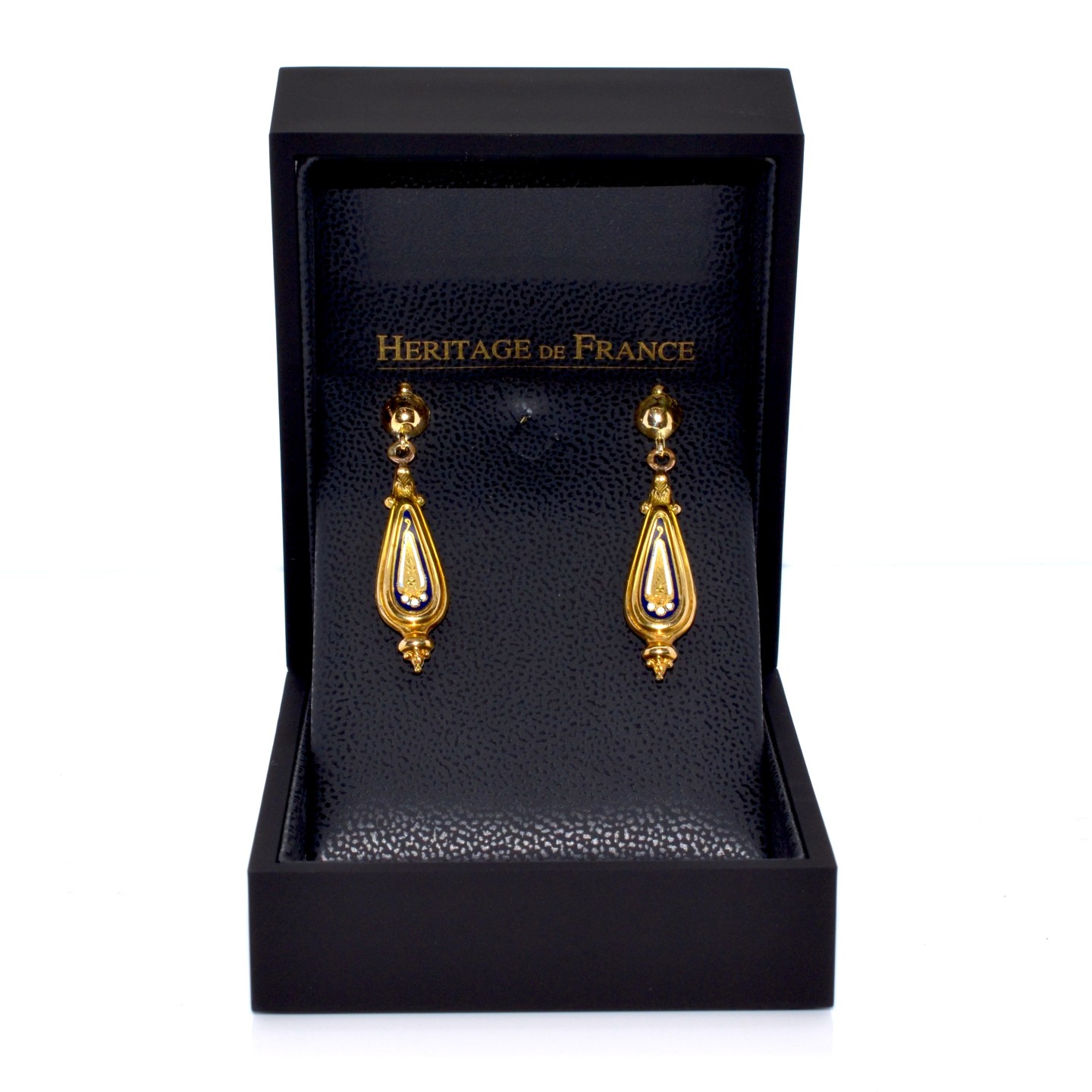
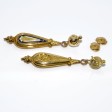
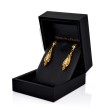
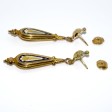
This beautiful pair of antique 18k yellow and rose gold earrings is very elegant.
Bleu and white enamel.
| Weight | 3,70 g |
|---|---|
| Lenght (cm) | 5 |
| Ref. | #7024 |
|---|
During the Second Empire, under the reign of Napoléon III (1852–1870), eighteen-carat gold earrings decorated with enamel formed a significant part of French jewelry production. They reflect a strong interest in color, material contrast, and technical complexity, all characteristic of this eclectic period. Eighteen-carat gold, the standard alloy in French jewelry, provided an optimal balance between mechanical strength and workability, which was essential for pieces incorporating enamel.
Enamel was applied using several techniques, most notably champlevé, cloisonné, and painted enamel. Each required precise control of firing temperatures and careful management of thermal expansion between the metal substrate and the vitreous enamel. Decorative programs were diverse and often historically inspired, including floral motifs, scrollwork, neo-Renaissance ornament, and classical or archaeological references. Common enamel colors included deep blue, black, green, and opaque white, selected for their visual contrast with gold. In some examples, enamel panels served as a ground for additional elements such as seed pearls, coral, or small gemstones.
Structurally, these earrings were produced in various formats, including pendant earrings, sleeper earrings (dormeuses), and hook-mounted designs. Particular attention was paid to weight distribution to ensure stability and comfort during wear. Enameled surfaces were typically framed by raised gold borders, which served both a decorative and protective function, reducing the risk of chipping or abrasion.
From a technical perspective, these earrings demonstrate a high level of craftsmanship: precise preparatory engraving, even enamel layering, controlled firing cycles, and careful assembly of articulated components. Today, Napoléon III–era enamel earrings are studied as complex objects at the intersection of jewelry, metalwork, and decorative arts, exemplifying a French tradition that combined technical rigor with rich surface treatment.