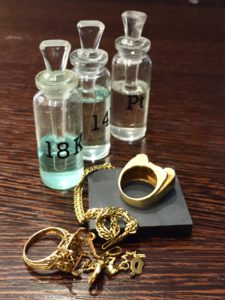
At Héritage de France®, we buy gold, platinum and other precious-metal jewelry at our jewelry store in Paris. Before making a purchase offer, we examine each piece to determine its nature, precious-metal content and, most importantly, whether it has value as a piece of jewelry beyond the value of its metal alone.
This distinction is particularly important for antique, vintage and signed jewelry, as well as pieces set with diamonds, precious gemstones or pearls. An Art Deco ring, a Tank bracelet, a signed jewel or a high-quality antique piece should not necessarily be valued solely according to its gold weight.
Our jewelry buying process is carried out in front of you, and the appraisal is complimentary whether or not you accept our offer.
You may bring us your jewelry as it is, including mixed collections or groups of pieces inherited from an estate.
We begin by examining the hallmarks and precious metals to identify, whenever possible, their fineness: 18K gold (750 parts per thousand), 14K gold (585 parts per thousand), platinum, silver or other precious-metal alloys.
We then identify pieces that may have additional value because of their period, design, quality of craftsmanship, gemstones, signature or relevance in the current market.
This examination takes place before any gold intended to be valued primarily for its precious-metal content is weighed.
Not all gold jewelry should be valued in the same way.
Some antique and vintage jewelry may be worth more than the precious metal it contains. Its period, condition, quality of craftsmanship and relevance in the antique jewelry market should therefore be taken into consideration.
The same applies to certain signed pieces. A signature, when consistent with the other characteristics of the jewel, can have a significant impact on its value.
At Héritage de France®, our daily experience buying and selling antique, vintage and pre-owned jewelry allows us to identify pieces that should be valued as jewelry before considering their precious-metal value alone.
When a piece is set with diamonds, sapphires, rubies, emeralds or certain pearls, these elements may also contribute significantly to its value.
We examine the gemstones before assessing the overall interest of the piece. Old-cut diamonds, for example, often have proportions and faceting that differ from modern brilliant-cut diamonds and should be evaluated accordingly.
For certain important gemstones, additional gemological examination may be necessary.
This assessment helps distinguish jewelry whose value is primarily based on its precious-metal content from pieces whose gemstones, craftsmanship or jewelry value justify a different valuation.
When jewelry or other objects are valued primarily for their precious-metal content, they are weighed on a scale accurate to one-hundredth of a gram.
We take into account their fineness and the current gold price at the time of the appraisal when preparing our purchase offer.
Our process can therefore be summarized in several steps:
examination of the jewelry and objects presented;
identification of hallmarks and precious-metal fineness;
selection of pieces with particular jewelry or market interest;
examination of gemstones when they may contribute to the value;
weighing of the remaining gold;
consideration of the current gold price;
presentation of a purchase offer.
If you accept our offer, payment is made immediately by bank check or instant bank transfer.
The entire process is complimentary, whether you accept or decline our purchase offer.
The examination is carried out in front of you so that you can follow the different stages of the appraisal and ask any questions you may have.
Having your jewelry appraised does not obligate you to sell it. A purchase offer is made only after the jewelry has been examined, and you remain free to accept or decline it.
Selling Inherited Jewelry
An inheritance or estate often includes a variety of jewelry whose nature and value can be difficult to determine without a professional examination.
A single collection may contain antique jewelry, vintage pieces, modern jewelry, signed pieces, diamonds and precious gemstones, as well as jewelry whose value is primarily based on its gold content.
It is therefore advisable to have the pieces examined before selling an entire collection solely by weight.
If you have a large number of pieces to be examined, we recommend making an appointment, as evaluating each piece individually may require additional time.
Before visiting our jewelry store in Paris, you may send us clear photographs of your jewelry. These images can give us an initial indication of the nature of the pieces and whether they may be of interest to us.
However, a reliable appraisal cannot be made from photographs alone. The metal, hallmarks, gemstones, weight, condition and technical characteristics of the jewelry must be examined in person.
For this initial review, photographing the jewelry next to a metric ruler can provide useful information about its dimensions.
Located at the entrance to the Village Suisse in Paris, Héritage de France® specializes in antique, vintage and pre-owned jewelry.
We buy gold and platinum jewelry, as well as pieces of particular interest because of their period, craftsmanship, diamonds or precious gemstones, signature or relevance in the antique jewelry market.
Our approach is simple: we examine the piece as a whole before determining whether it should be valued as jewelry or primarily for the precious-metal content it contains.