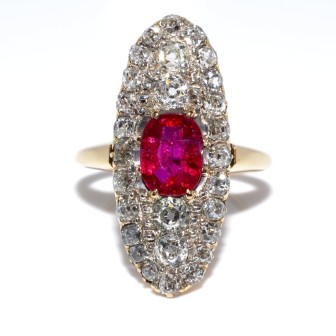
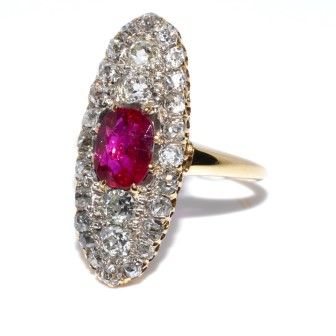
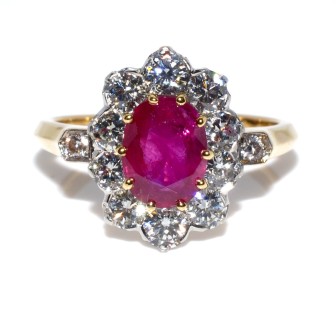
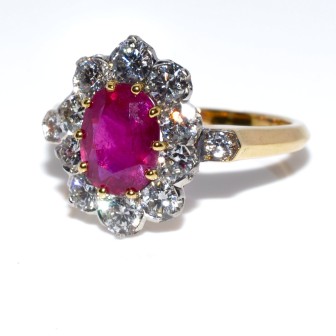
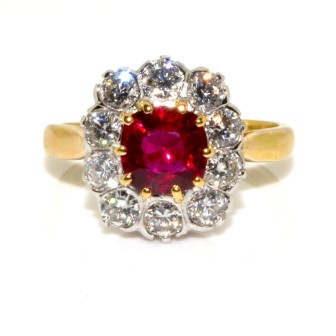
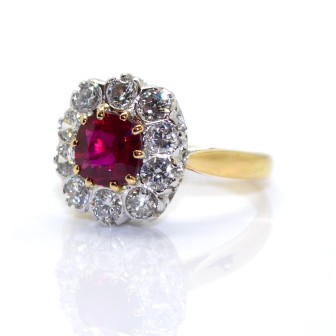
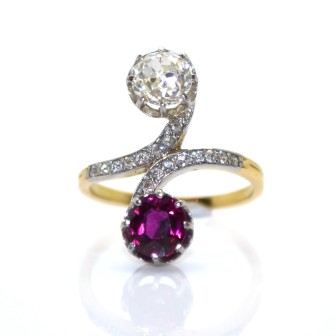
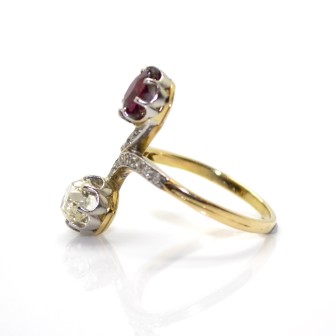
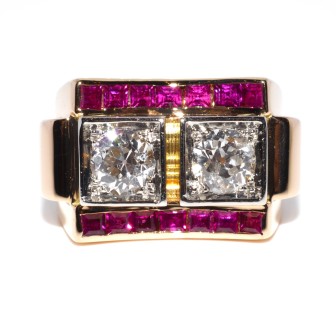
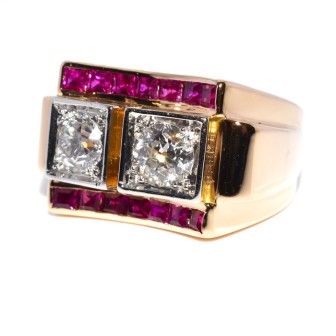
Ruby is particularly well suited for an engagement ring. Its red color lends itself to many different designs, from solitaires and diamond-surrounded Pompadour rings to three-stone, marquise, and Art Deco rings.
Like sapphire, ruby belongs to the corundum family. With a hardness of 9 on the Mohs scale, it is one of the hardest natural gemstones after diamond.
At Héritage de France®, we offer antique and vintage ruby engagement rings as well as more recent creations, some of which feature rubies removed from antique jewelry.
Color is one of the most important characteristics when evaluating a ruby. It can range from slightly pinkish red to deeper red, with significant variations in tone and saturation.
There is no single ideal color. Some people prefer a vivid red, while others favor a darker or slightly pinkish shade. It is primarily a matter of personal taste.
Two rubies of similar weight can look very different depending on their color, transparency, proportions, and cut.
Ruby lends itself to a variety of engagement ring designs.
In a solitaire, the ruby is the sole focal point. A Pompadour ring, or cluster ring, generally features a central ruby surrounded by a halo of diamonds. Three-stone rings may pair the ruby with two diamonds, while antique jewelry also includes marquise, elongated, and geometric Art Deco designs.
The choice depends on the shape and dimensions of the ruby, as well as the proportions of the setting and how the ring looks when worn.
At our store in Paris, our rings can be viewed and tried on without an appointment.
Unlike diamonds, rubies do not have a universal grading system comparable to the 4Cs.
Color plays an essential role, but transparency, inclusions, cut, proportions, and carat weight must also be considered.
Inclusions are common in natural rubies, and their presence is not necessarily a flaw. Some can provide useful information during the gemological examination of the stone.
Cut quality also influences the appearance of a ruby. Antique rubies may have less standardized proportions that contribute to their individual character.
Heat treatment has traditionally been used for some rubies to modify or improve their color and transparency.
A heated ruby remains a natural ruby and should not be confused with a synthetic ruby created in a laboratory.
Rubies showing no indications of heat treatment can be rarer and more sought after. However, the absence of heat treatment alone does not determine the quality or value of a stone.
For important rubies, the presence or absence of indications of heat treatment can be investigated by a gemological laboratory.
Rubies are found in several regions of the world, including Myanmar (Burma), Mozambique, Madagascar, and Sri Lanka.
Their geographic origin generally cannot be reliably determined through visual examination alone. It requires advanced gemological analysis and may sometimes remain inconclusive.
A particular origin may influence the interest and value of a ruby, but origin alone does not determine quality.
At Héritage de France®, we attribute a specific geographic origin to a ruby only when it is supported by the available gemological evidence.
It is important to distinguish between the age of the ruby, the period in which it was cut, and the age of the setting.
A ruby set in an antique ring may be original to the piece or may have been replaced. Conversely, a ruby removed from an antique piece of jewelry may later be reset in a new ring.
Some Héritage de France® creations therefore feature rubies removed from antique or vintage jewelry, examined and selected before being reset.
An antique ruby reset today remains an antique gemstone, but the new ring is a contemporary creation.
For an important ruby, a report issued by an independent gemological laboratory can help confirm that the stone is natural and determine whether indications of heat treatment are present. In some cases, the laboratory may also provide an opinion regarding geographic origin.
However, a gemological report is not an appraisal of the ring’s value. The setting, period, condition, hallmarks, and any diamonds accompanying the ruby must also be examined.
Héritage de France® presents a selection of antique, vintage, and contemporary ruby engagement rings at our jewelry store in Paris.
Pompadour, three-stone, marquise, Art Deco, and contemporary rings: the choice depends as much on the characteristics of the ruby as on the design and proportions of the setting.
Our store is open to the public, and you are welcome to visit and try on our rings without an appointment.
Résultats 1 à 14 sur 14