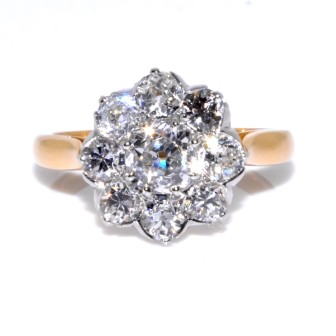
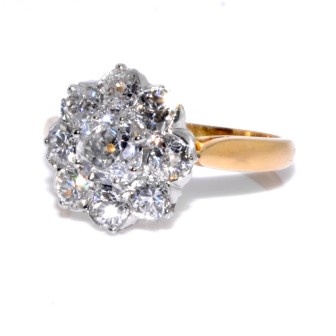
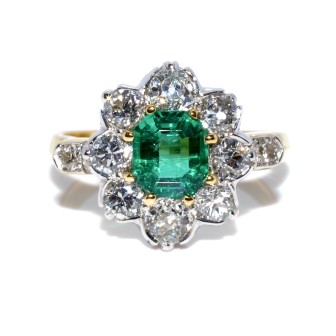
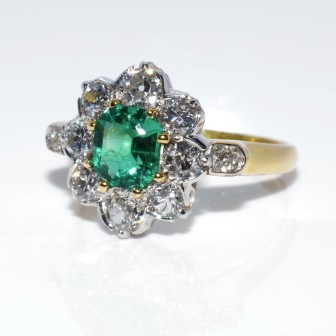
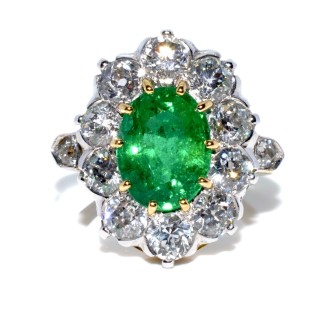
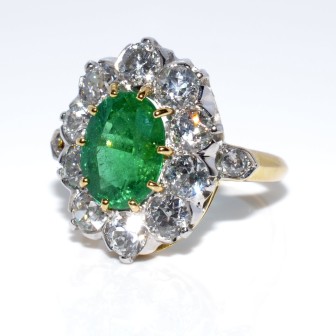
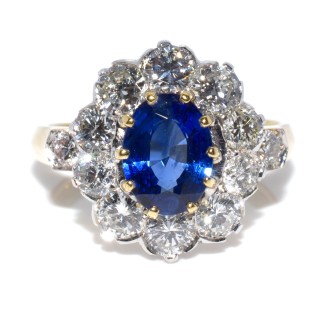
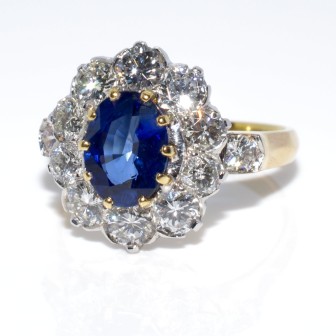
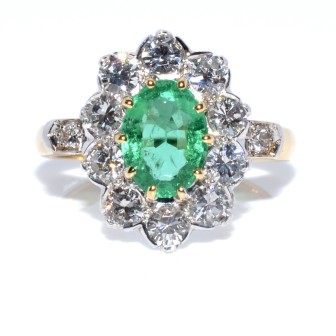
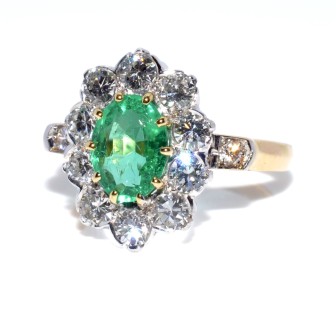
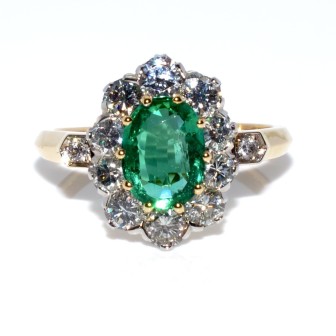
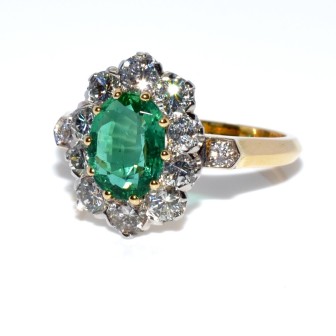
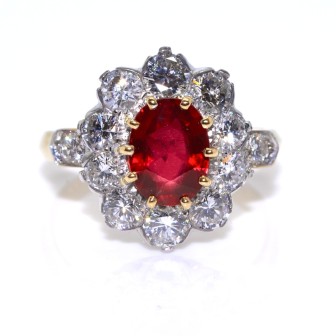
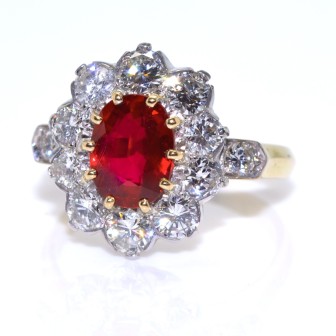
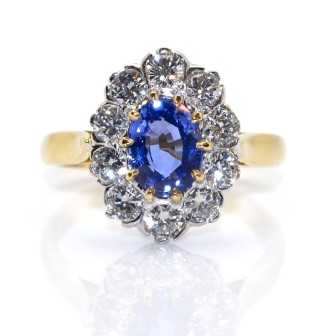
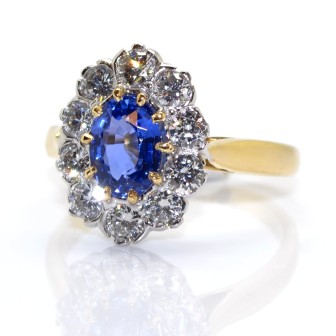
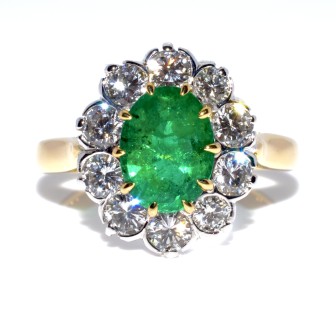
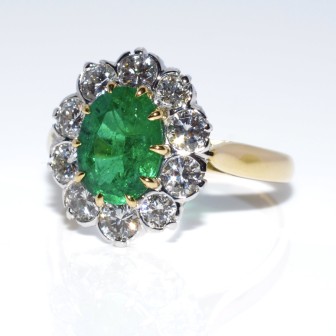
A Pompadour ring is characterized by a central gemstone surrounded by a regular halo of smaller stones, most commonly diamonds. In France, this construction is also known as a bague entourage and, in certain configurations, is closely related to the traditional bague marguerite or cluster ring.
The centre stone may be a sapphire, ruby, emerald or diamond, and is frequently oval, round or cushion-shaped. The diamond surround enhances the brilliance of the centre stone while visually increasing the overall dimensions of the ring.
This balanced architecture has become one of the classic designs of French jewellery.
The name refers to Jeanne-Antoinette Poisson, Marquise de Pompadour (1721–1764), the celebrated patron of the arts and influential figure at the court of Louis XV.
French jewellery tradition has associated her name with this style of cluster ring. The precise historical origin of the term, however, is difficult to establish. It is therefore more accurate to consider “Pompadour” a traditional French jewellery designation rather than to attribute the creation of the design directly to Madame de Pompadour.
A Pompadour ring should also not be confused with a marquise-cut gemstone, which has an elongated shape terminating in two points.
The traditional construction consists of a prominent centre stone surrounded by a regular halo of diamonds.
On antique examples, the setting itself can provide useful information about the period in which the ring was made. The construction of the basket, claws, stone settings, shoulders and decorative elements beneath the stones can all provide indications of age and craftsmanship.
Antique Pompadour rings may also feature old-cut or rose-cut diamonds, whose proportions and optical character differ noticeably from modern brilliant-cut diamonds.
Several precious metals may be combined within the same ring. 18k gold and platinum, for example, are frequently used together, with gold forming the shank while the diamonds are set in white metal.
A sapphire surrounded by diamonds is one of the most recognizable versions of the Pompadour ring. The contrast between the blue centre stone and the white diamonds clearly emphasizes the architecture of the design.
The same principle works particularly well with rubies, where the intensity of the red is highlighted by the diamond surround, and with emeralds, whose green provides a distinctive contrast.
Pompadour rings can also be composed entirely of diamonds. In these examples, the character of the ring depends more on the proportions and cuts of the stones and on the quality of the setting than on colour contrast.
At Héritage de France®, we offer both antique Pompadour rings and pieces created in our Paris workshop.
For some of our creations, we use sapphires, rubies, emeralds and diamonds removed from antique or vintage jewellery. These gemstones are carefully selected before being reset into rings inspired by traditional French jewellery designs.
We favour materials traditionally associated with fine French jewellery, particularly 18k gold and platinum, together with proportions inspired by fine antique examples.
This approach allows antique gemstones to be preserved and reused while creating a ring suitable for contemporary wear.
The quality of a Pompadour ring should not be assessed solely by the carat weight of its centre stone.
The colour, transparency and cut of the central gemstone should be considered alongside the quality and consistency of the surrounding diamonds. Proportion is particularly important: the diamond halo should enhance the centre stone without overwhelming it, while the complete compositi
Résultats 25 à 33 sur 33