7 600 €
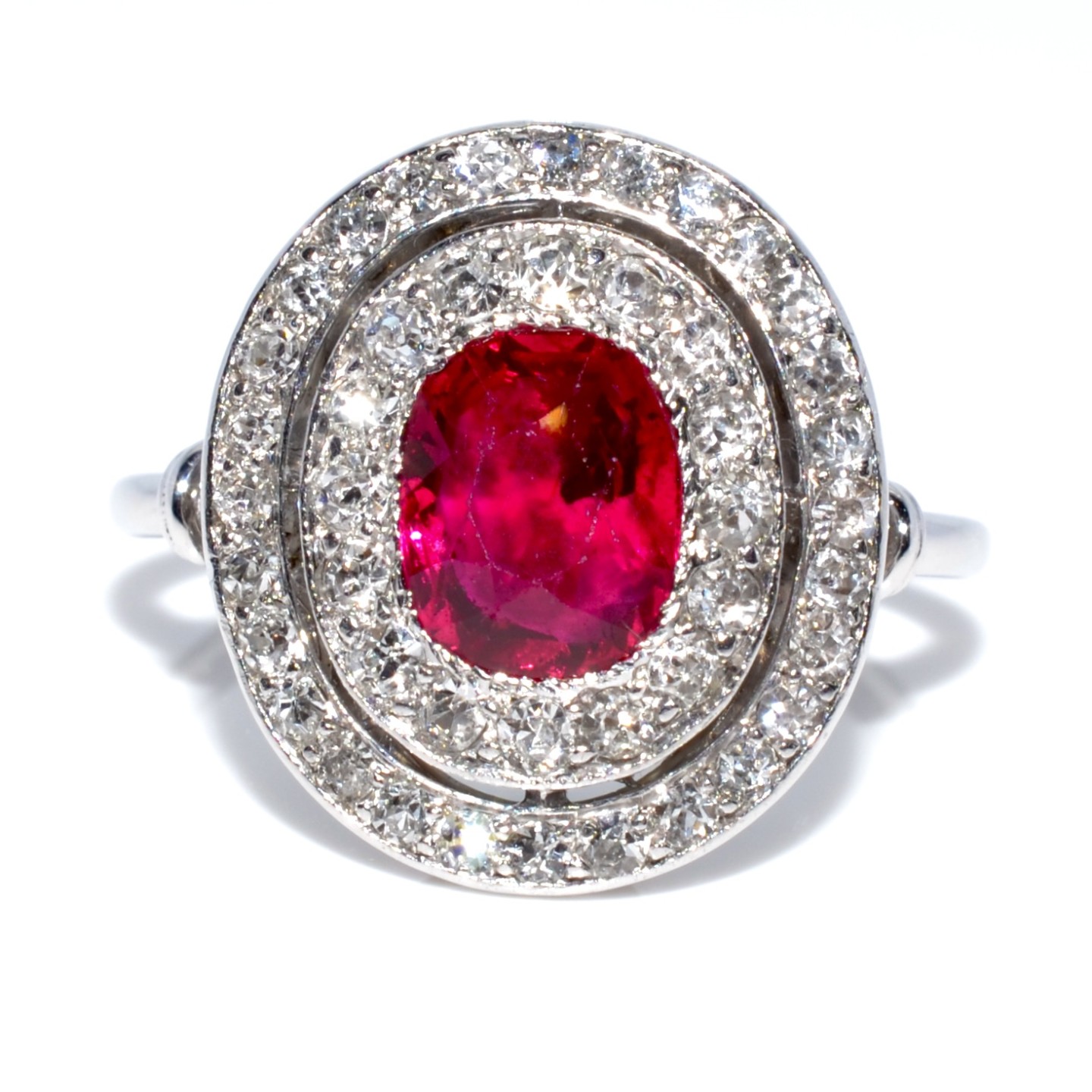
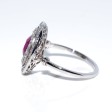
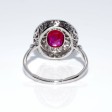
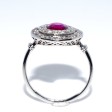
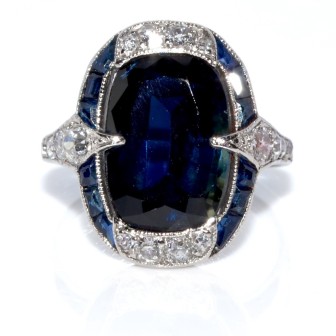
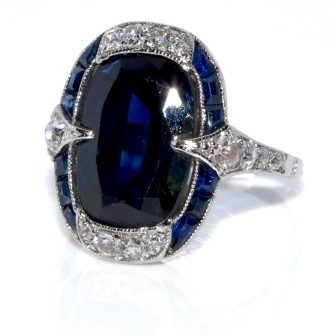
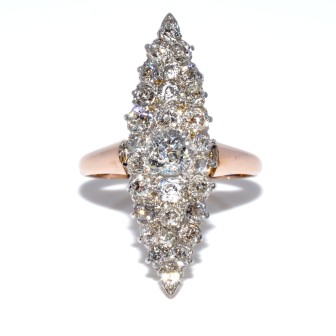
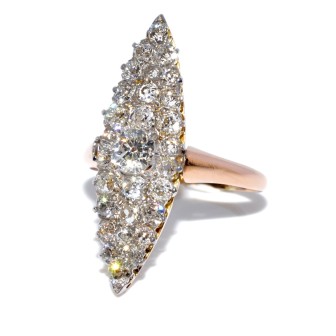
Hide pricesThis sublime Art Deco ring is set with a ruby weighing approximately 1.30 carats in the center. This ruby is from Burma and has not undergone any thermal treatment (unheated). It is incredibly crystalline (and therefore brilliant). Its beautiful deep red color is of rare intensity. It is surrounded by old-cut diamonds, which are also of very high quality (very white and very clean). A second band increases the volume of this ring.
The double band ring is a classic of the Art Deco period, circa 1920.
The ruby comes with its laboratory certificate, issued by Gem Paris.
|
Weight of the Ruby Origin Certificate Diamonds total weight |
approx. 1,30 ct Burma, No-Heat Gem Paris approx. 0,90 ct |
|---|---|
| Valued color & clarity | F-G/VS-SI |
| Weight | 6,00 g |
|---|---|
| Diameter (Top of the ring) (cm) | 1,5 x 1,3 |
| Ring size | 51 (can be resized) |
We deliver a certificate of authenticity
Please notice that our images are not photoshopped, we use a daylight environment (copyright - Heritage de France)
The jewel comes in a beautiful gift box
| Ref. | #6883 |
|---|
Around 1920, Art Deco rings set with Burmese rubies illustrate a decisive shift in jewelry design toward structure, precision, and technical discipline. This period marks a clear departure from the organic curves of Art Nouveau in favor of a geometric vocabulary based on symmetry, axial balance, and clearly defined volumes. The Burmese ruby, sourced primarily from the Mogok region, was highly prized for its saturated red color—often described as “pigeon’s blood”—as well as for its strong natural fluorescence resulting from high chromium content.
In Art Deco rings, the ruby was typically cut in calibrated shapes such as oval, cushion, or occasionally rectangular forms, allowing it to integrate seamlessly into rigid, architectural compositions. The stone was most often set using a closed bezel or sharply defined claw settings, designed to provide mechanical security while preserving strict visual order. Platinum became the preferred metal for these rings due to its tensile strength and resistance to deformation, enabling thinner mountings and highly precise stone setting. Diamonds, frequently cut as baguettes or early brilliants, were commonly used as accent stones to emphasize contrast and linearity.
From a technical standpoint, these rings demonstrate a high level of execution. Stone alignment is exact, tolerances are tight, and mount thickness is carefully controlled to ensure both durability and proportional consistency. Decorative elements are minimal, with emphasis placed on construction, material quality, and functional clarity rather than ornamental excess.
Today, Art Deco rings set with Burmese rubies are examined as much for their gemological properties as for their engineering and design logic. They represent a moment when jewelry became deliberately modern, prioritizing structure, longevity, and precision over expressive embellishment.