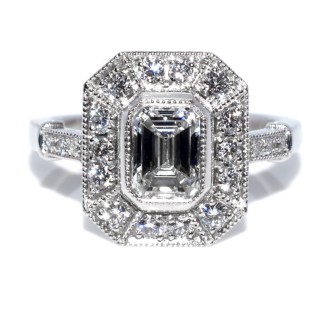
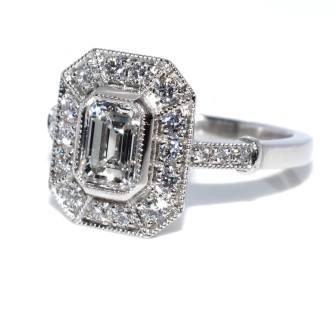
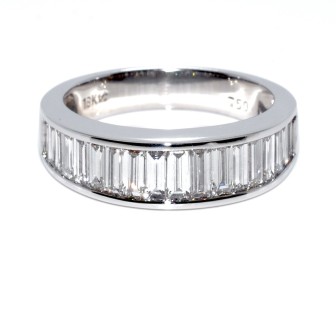
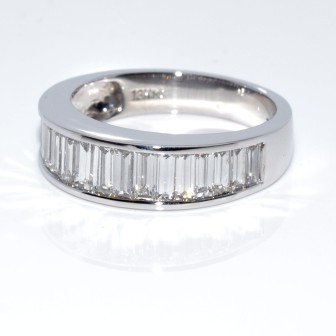
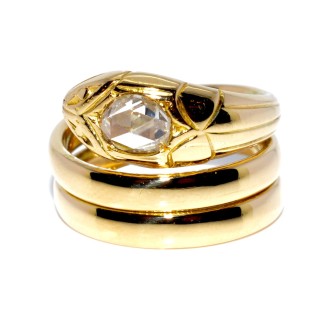
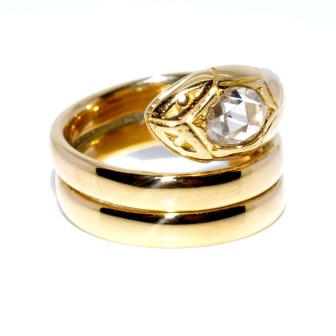
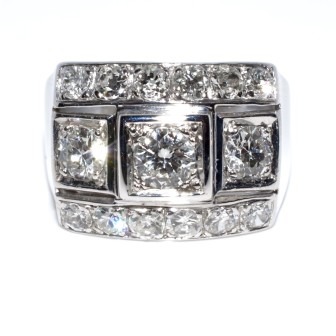
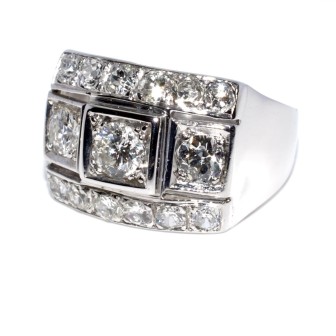
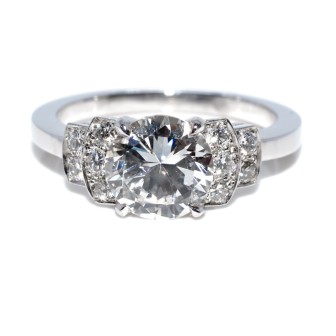
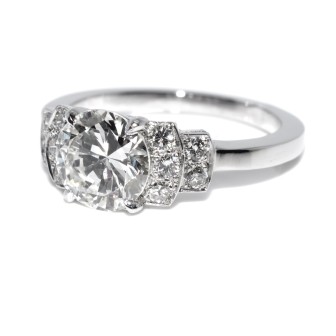
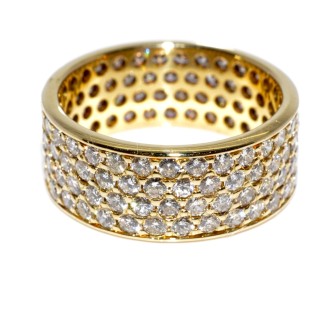
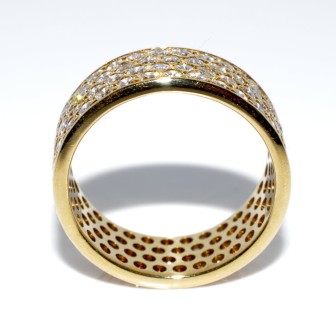
The diamond remains the gemstone most closely associated with engagement rings. Its exceptional hardness, brilliance and wide variety of cuts make it equally suited to a solitaire, Pompadour ring, three-stone ring or Art Deco setting.
Choosing a diamond engagement ring, however, is not simply a matter of comparing the weight or quality of different stones. The design of the setting, the proportions of the diamond, the way it is set and the overall balance of the ring on the hand all contribute to the character of the piece.
At Héritage de France®, we offer antique and vintage rings as well as more recent creations, some of which feature diamonds removed from antique jewelry.
The solitaire is the most classic design. A single diamond forms the centerpiece of the ring, making its cut, proportions and setting particularly important.
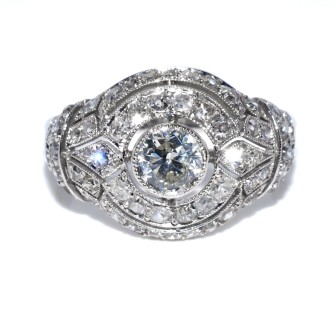
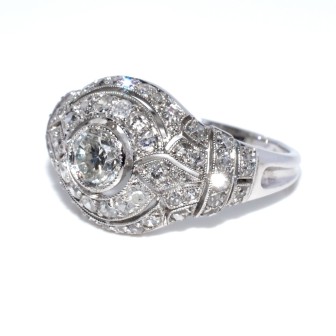
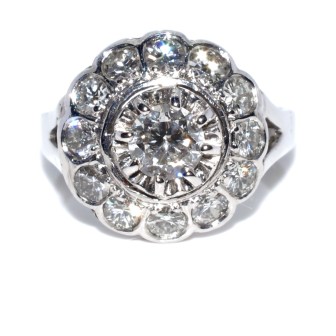
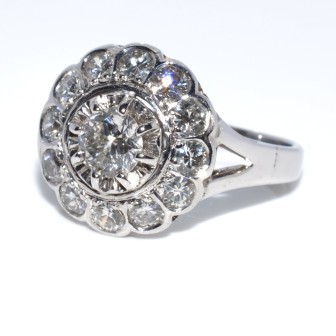
A Pompadour ring, also known as a cluster or halo ring, features a central diamond surrounded by smaller diamonds. The surrounding stones increase the ring’s visual presence and allow for a wide variety of proportions.
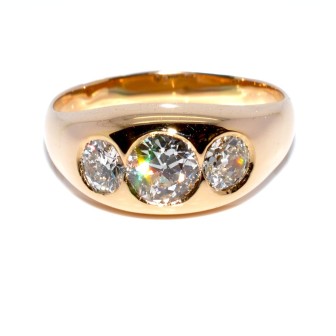
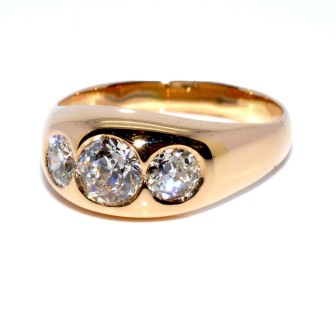
A three-stone ring features three principal diamonds, typically with a larger center stone flanked by two smaller stones.
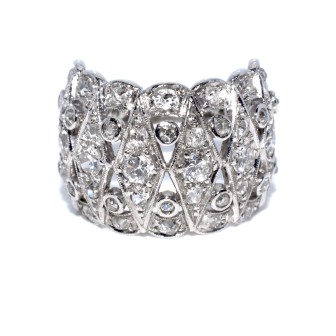
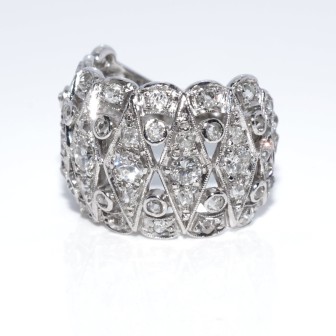
Authentic period Art Deco rings, primarily from the 1920s and 1930s, take a different approach: the diamond may be incorporated into a more complex geometric composition, often crafted in platinum.
The choice therefore depends as much on the type of ring as on the diamond itself.
Diamonds are commonly evaluated according to the 4Cs: Carat, Color, Clarity and Cut.
Carat measures a diamond’s weight, not its dimensions. Two diamonds of identical carat weight may have different diameters depending on their proportions.
Color in white diamonds is generally graded on a scale from D to Z, with D representing the absence of perceptible color under standardized grading conditions.
Clarity describes the internal and external characteristics observed when examining the diamond.
Finally, cut directly affects how a diamond interacts with light. Modern round brilliant diamonds may receive a laboratory cut grade. Antique diamonds, however, should be considered in the context of their individual proportions and the period in which they were cut.
The 4Cs are therefore important comparative tools, but they do not by themselves determine the visual appeal of a diamond or the quality and character of the ring in which it is set.
Old-cut diamonds were fashioned before modern diamond cuts became standardized. Their proportions and faceting can differ significantly from those of contemporary brilliant-cut diamonds.
Examples include rose cuts, antique cushion cuts and various forms of old European cuts.
Their faceting often varies considerably from one stone to another. Broader facets, a smaller table, a higher crown or a visible culet are among the characteristics found in certain antique diamonds.
These features should not necessarily be regarded as imperfections. They reflect cutting techniques and approaches to light performance that differ from those used for the modern brilliant cut.
There is no single answer.
A modern brilliant-cut diamond generally has more standardized proportions and may be accompanied by a detailed assessment of its cut quality.
An antique diamond has a different appearance, often with less standardized faceting and a visual character unique to each stone.
The choice therefore depends on the desired aesthetic. An antique diamond can be particularly well suited to a period ring or to a newly made setting designed around its specific proportions.
The age of the diamond’s cut and the age of the ring itself should, however, always be distinguished.
An antique diamond ring is a ring whose setting was genuinely made during the historical period to which it is attributed. Its diamond may be original to the ring or may have been changed at some point during the history of the piece.
A Héritage de France® creation featuring an antique diamond is different: the diamond comes from an antique or vintage piece of jewelry, while the setting is newly made.
When certain antique pieces can no longer be preserved in suitable condition, their diamonds may be removed, examined and selected for use in a new creation.
This distinction is essential: an antique diamond set today remains an antique-cut diamond, but the newly made ring is a contemporary creation.
A round diamond is not the only option for an engagement ring.
Oval, cushion, pear, marquise and emerald cuts offer very different proportions and effects on the hand. Some visually elongate the finger, while others create a more compact presence.
In an antique ring, the shape of the diamond is often closely related to the construction of the original setting. In a new creation, the setting can instead be designed around the precise dimensions of the selected stone.
The choice should therefore consider both the shape of the diamond and the architecture of the ring.
For important diamonds, a report issued by an independent gemological laboratory can provide precise information about the characteristics of the stone.
A gemological report is not an appraisal of monetary value and does not replace an examination of the jewelry itself.
With an antique ring, the setting, stone settings, hallmarks and overall condition of the piece should also be examined, as these elements are not covered by a diamond grading report.
At Héritage de France® in Paris, we offer a selection of antique, vintage and contemporary diamond engagement rings.
Our collection includes solitaires, Pompadour rings, three-stone rings, Art Deco rings, marquise rings and cluster designs, featuring modern or antique diamonds depending on the piece.
Some rings are entirely antique or vintage. Others are Héritage de France® creations made, in particular, with diamonds removed from antique jewelry, selected and reset in newly made settings.
Each ring is examined not only for the characteristics of its diamonds, but also for its design, proportions, precious metals, settings and overall condition.
Choosing a diamond engagement ring is therefore not simply a matter of comparing gemological grades: it is about finding the right balance between the diamond, the setting and the character of the ring.
Résultats 145 à 154 sur 154